

A dog's feeding chart is a starting point, not a prescription: the manufacturer's bag tells you where to begin, and the dog's body condition tells you where to stop. Everything else in pet wellness and supplies — how you measure, what you store, which supplements are worth buying, how you pay for it all — hangs off that one loop of feed, observe, adjust. The sections below walk through the decisions in the order most owners actually face them.
How much to feed, and why the bag is only a starting point
Use the body-weight table on the bag to set a starting amount, then adjust by roughly 10 percent at a time every couple of weeks until the dog's ribs are easy to feel under a thin layer of fat and there is a visible waist from above. Manufacturer charts are built for typical, moderately active dogs, and most pets sitting in a suburban living room are less active than "typical."
The ranges themselves are wide, which tells you something. Manufacturer guidance for adult dry food gives 1-1/3 to 2 cups per day for a 21–35 lb dog, and 3-1/3 to 4-1/4 cups per day for a 76–100 lb dog. Above 100 lb, the same guidance adds 4-1/4 cups plus 1/4 cup for each additional 10 lb of body weight per day. A formula-specific label narrows it: Purina Pro Plan Performance 30/20 lists 3 to 3-1/2 cups per day for 76–100 lb dogs, while Purina Pro Plan Weight Management Large Breed lists 5 cups plus 1/3 cup for each 10 lb over 100 lb for maintenance — a bigger volume because the food is diluted in calories. Small breeds run the other direction: Purina Pro Plan Small Breed Chicken & Rice lists 1/3 to 1 cup per day for 3–12 lb dogs, and the Small Breed Adult 7+ formula lists 1/3 to 3/4 cup per day for the same weight band. Same weight, different formula, different cup count. Read the label of the bag in your kitchen, not a number you remember.
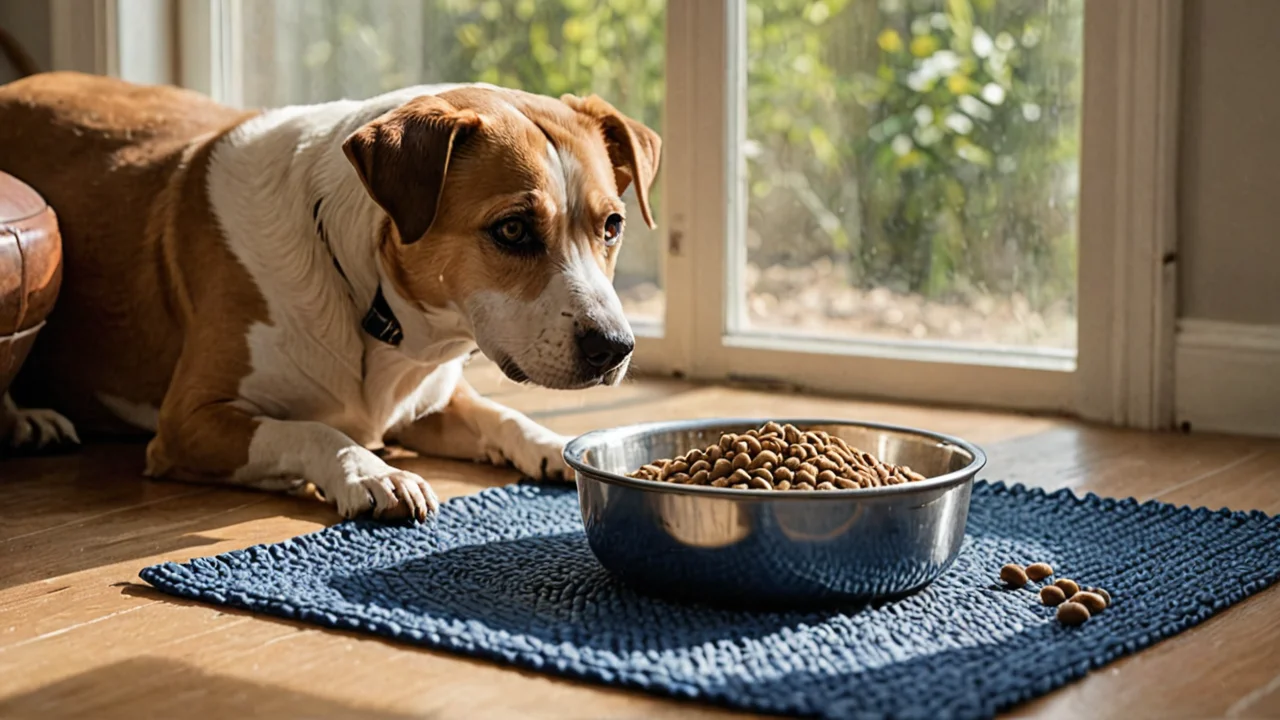
Two things go wrong most often. The first is the measuring cup. Label amounts assume a standard 8 oz/250 ml measuring cup holding a stated number of grams of that specific product — a random scoop from the kitchen drawer can be off by a third or more, and a cup of one kibble weighs differently from a cup of another. Use the cup the label describes or weigh the food in grams on a kitchen scale. The second is treats and toppers, which owners almost never count. If a dog is gaining on the label amount, the extras are the first place to look, not the kibble.
Puppies, pregnant and nursing dogs, and dogs on a weight-loss program should not be managed off the adult maintenance column. Those are different nutritional targets, and the label will say which life stage the food is for.
Reading a pet food label without getting fooled by the marketing
Look for an AAFCO nutritional adequacy statement on the label before anything else. That statement — "complete and balanced" for a named life stage, substantiated either by feeding tests or by formulation to meet AAFCO nutrient profiles — is the only thing on the package that speaks to whether the food can be a dog's sole diet. Purina Pro Plan formulas, for example, state on their labels that animal feeding tests using AAFCO procedures substantiate complete and balanced nutrition for maintenance of adult dogs or for all life stages, including growth of large sized dogs.
AAFCO feeding tests are standardized animal trials defined by the Association of American Feed Control Officials, evaluating whether a food, fed as the sole source of nutrition, provides complete and balanced nutrition for the intended life stage. A "maintenance" diet is one tested for healthy adults not growing, reproducing, or doing intense work — which is most pets. A food labeled for "all life stages" including large-breed growth has met a stricter bar than a maintenance food, and that matters for a puppy of a large breed.
The common mistake is treating the AAFCO feeding-test statement as a quality ranking. It isn't. It confirms a diet met the standard through feeding trials rather than only through formulation; it does not tell you one tested food beats every formulated-only food, and it says nothing about ingredient quality, sourcing, or whether your particular dog digests it well. Ingredient splashes on the front of the bag — "real chicken first," pictures of vegetables — are marketing. The guaranteed analysis and the adequacy statement are the substance, and both are required. A food that meets the standard but gives your dog loose stools is still the wrong food for your dog.
What this costs: feeding-test substantiated foods from established manufacturers generally cost more per pound than store-brand kibble, and the premium buys you a documented nutritional claim and tighter formulation control, not magic. If budget is tight, a formulated-to-profile food that meets AAFCO standards for your dog's life stage is a legitimate choice — you are trading the feeding-trial evidence for a lower price, not buying an unsafe food.
Digestion, transitions, and what a normal gut actually does
Switch foods over roughly a week, blending increasing proportions of the new food into the old, because a dog's gut adapts to a diet and an abrupt swap is a common cause of vomiting and diarrhea. The transit numbers explain why timing matters: in a peer-reviewed scintigraphy study in Beagle dogs, mean gastric transit time after feeding was 829 minutes — close to 14 hours — while esophageal and intestinal transit times were shorter and differed between pre- and post-feeding measurements. Food sits in the stomach far longer than most owners assume, so a new food introduced today can produce loose stool a day or two later, and owners often blame the wrong meal.
Gastrointestinal transit varies by segment, which is also why "my dog threw up undigested food hours later" is usually a stomach-emptying issue rather than a poisoning, and why a dog who vomits repeatedly or can't keep water down needs a vet rather than a food change. Persistent diarrhea, blood, or a dog that stops eating for more than a day are veterinary problems, not supply problems.
Probiotics and digestive supplements are worth trying during a transition or after a course of antibiotics, but they are adjuncts, not treatments. A supplement cannot fix a food that doesn't suit the dog, and the evidence for most specific strains in dogs is thinner than the packaging implies. The cheap, reliable interventions are a slow transition, consistent meal times, and not free-feeding a dog who bolts its food.
Supplies that earn their space, and the ones that don't
Buy the boring things well and skip most of the rest. A kitchen scale accurate to a gram, a set of stainless steel bowls you can dishwasher, an airtight food storage container that holds the whole bag (or the bag itself, folded and clipped), a fixed-length leash, a well-fitted harness, nail clippers or a grinder, and a toothbrush with pet enzymatic toothpaste cover the overwhelming majority of day-to-day wellness needs.
Food storage deserves a specific note. Kibble oxidizes and goes stale once the bag is open, and pouring it into a bin means you lose the lot number and best-by date — the two things you need if there is ever a recall. Keep the bag, or cut the label off and tape it inside the bin. Don't store food in the garage in summer; heat and humidity degrade fats and invite mold.
- Worth it: a gram scale, a dental routine, a harness that doesn't rub, a raised feeder only if your vet has recommended one for a specific condition.
- Sometimes worth it: a slow feeder for a gulper, a puzzle toy for a dog left alone, a probiotic during transitions, joint supplements for a large-breed dog showing stiffness — discuss with your vet before starting.
- Usually skip: automatic feeders that dispense by volume without calibration, "dental" chews that are mostly calories, water additives marketed as substitutes for brushing, and any supplement sold with a cure claim.
The trade-off with all of this is time versus money. Brushing a dog's teeth takes two minutes a day and costs almost nothing; a professional dental cleaning under anesthesia costs far more and carries anesthetic risk. Buying a good harness once costs more than a cheap one you replace twice. None of these choices are dramatic individually; they compound.
Paying for pet wellness, including what benefits won't cover
Pet food is not an eligible SNAP purchase. USDA Food and Nutrition Service guidance on eligible food items explicitly lists pet foods under nonfood items, so dog and cat food cannot be bought with SNAP benefits or an EBT card, no matter how the household budget is stretched. Anyone who tells you otherwise — including a cashier who lets it through — is wrong, and the transaction can be reversed. The same exclusion generally applies to pet supplies, vitamins for pets, and live animals.
What that means practically is that pet food has to come out of cash, and the planning question is whether to budget for it monthly or absorb it when it happens. Pet insurance is the other lever. Policies generally reimburse veterinary costs after a deductible and reimbursement percentage, exclude pre-existing conditions, and do not pay for food, routine supplies, or grooming unless you buy a specific wellness add-on — and even those add-ons typically cap routine care at a modest annual amount. Read the exclusion list before the premium: the exclusions are where the money is.
The honest trade-off is that insurance rewards owners who start it young and healthy, before anything is on the record. For an older dog with a known condition, the math usually doesn't work, and a dedicated savings account is the more flexible option — it just doesn't protect you against a single large bill the way a policy can. Neither approach pays for kibble.
Weight, life stage, and the check you do at home
Weigh the dog monthly and body-condition score it at the same time, because the scale alone won't tell you whether the weight is fat or muscle. A body-condition score is a hands-on assessment: ribs felt easily under a thin fat layer, a waist visible behind the ribs from above, an abdominal tuck from the side. Most adult dogs should sit at a moderate score, and a dog drifting upward over several months is the signal to cut the portion rather than wait for a vet visit to confirm it.
Life stage changes the target more than most owners expect. A puppy moves from growth formula to adult maintenance at a breed-size-dependent age your vet should set. A senior small-breed dog may need a senior formula — Purina Pro Plan Small Breed Adult 7+ lists a lower daily range than the standard Small Breed Chicken & Rice for the same 3–12 lb weight band, reflecting both different calorie density and different expected activity. A large-breed dog past 100 lb on a weight-management food is eating a larger cup volume than a maintenance formula would call for, because the food is less calorie-dense; owners who "cut back" by switching to a weight food without reading the new chart often overfeed.
What this costs you is attention, mostly. The measurement, the monthly weigh-in, and the slow adjustment are free; the failures are expensive, because obesity in dogs is linked to joint disease and shortened lifespan and the treatment is a prescription diet plus repeated vet visits. The limits are equally real: a dog that gains weight on a measured, label-appropriate portion despite no extra treats needs a vet visit to rule out thyroid or other disease before you cut the food further, and a dog losing weight without explanation needs one sooner.
The whole system comes down to a repeatable loop. Measure with the cup the label describes or weigh in grams. Feed to the body-condition score, not the bag. Read the AAFCO adequacy statement and the life stage before you buy. Transition slowly. Keep the bag and its lot number. Budget for food in cash, because SNAP won't cover it. And when the dog stops eating, vomits repeatedly, or changes weight without a change in feeding, that's a veterinary question, not a shopping one.