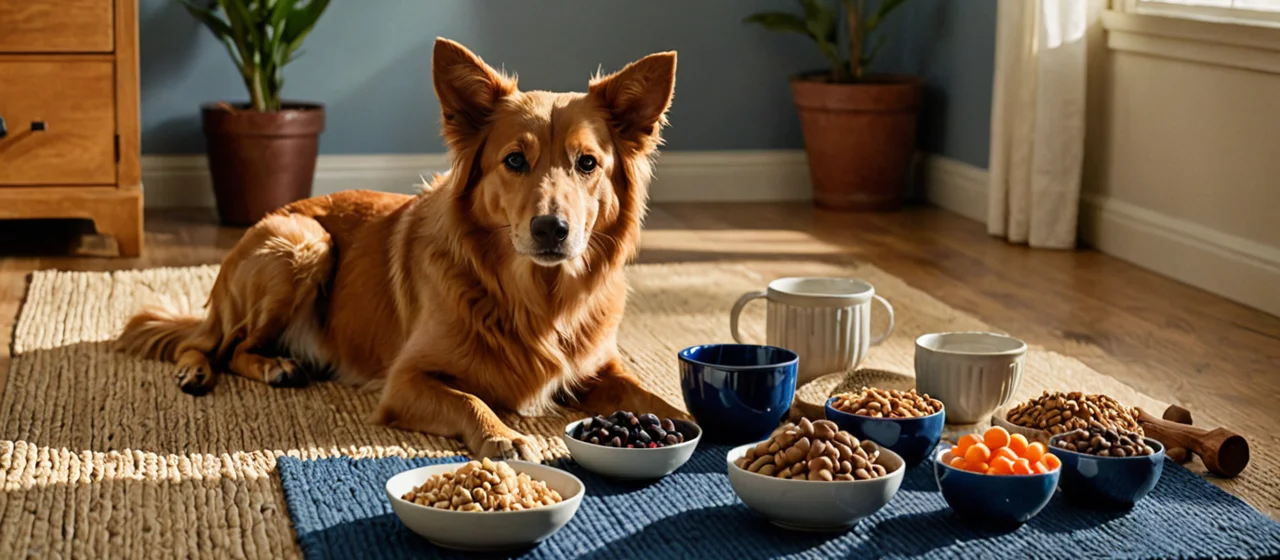



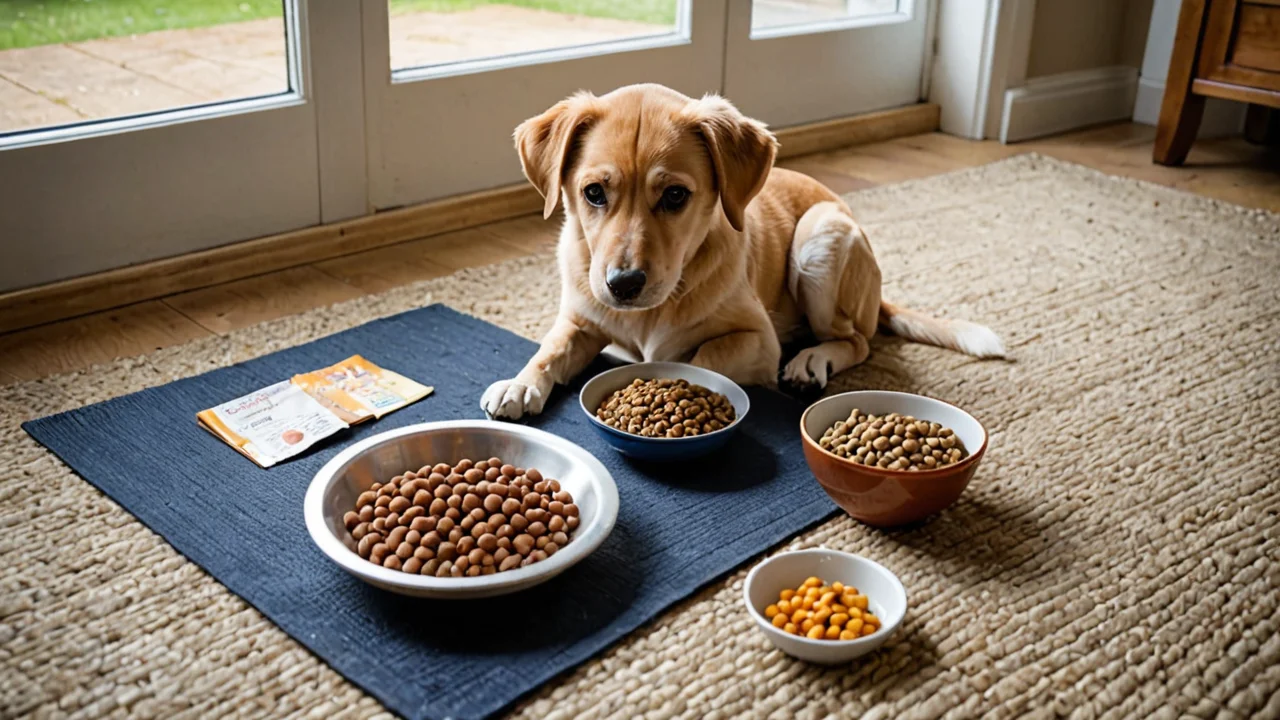


Feed a complete and balanced commercial diet that carries an AAFCO statement for your dog's life stage, measure it with the cup the label was written against, and adjust from there based on body condition rather than the chart alone. That single sentence is the whole of canine nutrition basics for most households. Everything below is the working detail: what the label is actually telling you, how the numbers on the bag were derived, where the feeding chart misleads, and which decisions cost real money or real risk.
What "complete and balanced" actually certifies, and what it doesn't
A food labeled complete and balanced has either been formulated to meet AAFCO nutrient profiles or has passed AAFCO feeding trials, and the label must say which. Those are two different claims. Formulated-only means the recipe was calculated to hit the nutrient targets on paper. Feeding-trial language means the finished product was fed as the sole diet to dogs under standardized conditions defined by the Association of American Feed Control Officials and the animals stayed healthy. Purina Pro Plan formulas, for example, state on their labels that animal feeding tests using AAFCO procedures substantiate that the products provide complete and balanced nutrition for maintenance of adult dogs or for all life stages, including growth of large sized dogs.
The trade-off is that a feeding-trial statement is not a quality ranking. It confirms the diet met AAFCO standards through animal feeding rather than formulation alone, and nothing more. A formulated-only food from a company with a board-certified veterinary nutritionist on staff can be excellent; a feeding-trial food can still be a poor fit for an individual dog with a sensitive gut or a skin problem. The claim tells you the food won't cause a deficiency when fed as the sole diet. It does not tell you your dog will thrive on it, and it does not tell you the kibble is better than the can next to it on the shelf.
Where labels genuinely fail is the gap between "adult" and everything else. A maintenance diet is formulated and tested for healthy adult animals not engaged in growth, reproduction, or intense work. Feed a maintenance food to a pregnant bitch, a nursing litter, or a growing large-breed puppy and the AAFCO statement no longer covers what you're doing with it. Large-breed puppies in particular need a growth claim that specifically covers growth of large sized dogs, and "all life stages" is the phrase to look for if you want one bag to do both. This is the single most consequential label reading decision a new owner makes, and it costs nothing to get right.
The limit: no AAFCO statement covers therapeutic diets. If your dog has kidney disease, struvite stones, pancreatitis, or a diagnosed protein-losing enteropathy, the prescription diets that treat those conditions sit outside the complete-and-balanced framework as ordinary maintenance foods, and a veterinary nutritionist should be steering. Over-the-counter "sensitive stomach" formulas are maintenance foods with marketing attached.
How much to feed: the chart is a starting point, not a prescription
Manufacturer feeding charts are weight-band tables, and the number jumps between bands is where people get into trouble. A manufacturer guideline for adult dogs puts a 21–35 lb dog at 1-1/3 to 2 cups of dry food per day, while a 76–100 lb dog lands at 3-1/3 to 4-1/4 cups per day, and dogs over 100 lb get 4-1/4 cups plus 1/4 cup for each additional 10 lb of body weight per day. That's a wide range within each band for a reason: the chart is built for a typical adult of that weight at typical activity, and your dog is probably not typical.
Formula-specific charts are tighter and more useful. Purina Pro Plan Performance 30/20 lists 3 to 3-1/2 cups per day for 76–100 lb dogs, well below the generic large-breed range, because the food is denser in calories per cup. Weight management formulas run the other direction: Purina Pro Plan Weight Management Large Breed for dogs over 100 lb on maintenance calls for 5 cups plus 1/3 cup for each 10 lb over 100 lb per day, because the calories per cup are deliberately low so the dog gets volume without the energy. Small breed formulas shrink the numbers again — Purina Pro Plan Small Breed Chicken & Rice recommends 1/3 to 1 cup per day for 3–12 lb dogs, and the Small Breed Adult 7+ version recommends 1/3 to 3/4 cup per day for the same weight band. Same brand, same weight range, different cups, because the formulas differ.
This is why switching foods without re-reading the bag is the most common feeding error there is. A cup of one kibble is not a cup of another in calorie terms, and the label numbers are not transferable. The practical sequence: pick the food, find the weight band, start at the low-to-middle end of the range, feed that for two weeks, then judge by body condition. You want ribs you can feel under a thin fat layer but not see, a waist behind the ribcage from above, and a tuck from the side.
Two things go wrong repeatedly. First, people free-feed and then wonder why the dog is heavy — a chart amount means nothing if the bowl is never empty. Second, people treat the top of the range as the target, when for a couch potato it's usually too much. The honest cost of getting this right is a kitchen scale and a fortnight of paying attention, and the honest cost of getting it wrong is a dog carrying extra weight for years.
Measuring cups, grams, and why your cup is not the label's cup
The feeding amounts on a bag are written against a defined cup, not the mug you keep in the kibble bin. Purina Pro Plan labels specify that recommended feeding amounts are based on a standard 8 oz/250 ml measuring cup containing approximately a stated number of grams of the product, which lets you convert cups to grams exactly. Use a proper 8 oz dry measuring cup, level it off, and don't scoop from a deep bin where the kibble packs down — a heaped scoop from a full bin can run well over the label's cup.
If you want precision — and for weight-loss diets, small breeds, and multi-dog households you probably do — buy a kitchen scale and feed by grams. The label gives you the grams-per-cup figure; multiply out your target and weigh it. This removes the entire class of error where two people in the same house scoop differently. It costs about the price of a coffee and five seconds per meal.
The limit is that grams give you precision, not accuracy. Weighing an amount that is wrong for your dog's metabolism just makes you wrong more consistently. The scale fixes measurement; body condition scoring fixes the target. Do both.
Timing, meal frequency, and what actually happens after your dog eats
Adult dogs do fine on two meals a day, and twice daily is the practical default because it splits the load on the stomach and gives you two chances to notice a dog who's gone off food. Puppies under roughly four to six months do better on three or four smaller meals, but that's a husbandry convention rather than something the label dictates.
What the research does tell you is that the stomach holds food a long time. A peer-reviewed scintigraphy study in Beagle dogs reported a post-feeding mean gastric transit time of 829 minutes — close to fourteen hours — while esophageal and intestinal transit times were shorter and differed between pre- and post-feeding measurements. That single number explains a lot of owner experience: a dog who vomits bile in the early morning is often running on an empty stomach overnight, and the fix is usually a later dinner or a small biscuit at bedtime rather than a change of food. It also explains why "he ate something he shouldn't have" is a wait-and-watch situation more often than an emergency, and why a dog who vomits repeatedly after a meal deserves a vet call rather than another bowl.
Gastric transit varies by segment and by whether the dog has eaten, so don't read 829 minutes as a rule for every dog or every meal — it's a mean from one breed in one study, and individual dogs scatter around it. The useful takeaway is directional: food sits in the stomach far longer than most owners assume, which is why meal spacing matters more than meal size for dogs prone to vomiting or bloat. For deep-chested breeds at risk of gastric dilatation-volvulus, feeding one large meal and then vigorous exercise is the combination to avoid; two smaller meals and a quiet hour after eating is the cheap precaution.
Wet, dry, raw, and homemade: what each choice costs you
Dry food is the default because it's cheap per calorie, shelf-stable, and the feeding charts are built for it. Its cost is palatability and water intake — kibble carries very little moisture, and dogs who eat only dry food drink more from the bowl, which matters for any dog with a history of urinary crystals. Canned food costs substantially more per calorie and is mostly water, but it's the simplest lever for a dog who won't drink enough or won't eat at all.
Raw and homemade diets are where the risk concentrates. A homemade diet that isn't formulated by a veterinary nutritionist is the classic route to a calcium-phosphorus imbalance in a growing puppy, and "I add a multivitamin" does not fix it, because the gaps are usually in macronutrient ratios and amino acid balance rather than in vitamins. If you want to cook for your dog, the honest cost is a consultation with a board-certified veterinary nutritionist and a recipe you follow by weight, not a blog recipe you scale by eye. Raw feeding adds a bacterial contamination risk to the household — the dog, the bowl, the counters, and anyone immunocompromised living there.
None of these choices changes the core arithmetic. Whatever you feed, it has to be complete and balanced for the life stage, and it has to be measured. A raw diet fed by the handful is no more principled than kibble fed by the handful.
Cost, food assistance, and the budget decisions owners actually face
Pet food is not an eligible purchase under SNAP. USDA Food and Nutrition Service guidance on eligible food items explicitly lists pet foods under nonfood items that cannot be purchased with SNAP benefits, so dog and cat food cannot be bought with SNAP EBT — this is a common belief that is simply wrong, and it catches people out at the register. If money is tight, the workable levers are buying the largest bag your dog will finish before it goes stale, storing it sealed and off the floor, and choosing a complete-and-balanced house brand over a premium bag you can only half-afford. Switching a dog onto a cheaper food abruptly is worse than a gradual transition over a week, and a dog who refuses food for several days is a vet problem, not a budget problem.
The trade-off in premium foods is real but narrower than marketing suggests. You are paying for consistency, feeding-trial substantiation, and tighter manufacturing control — not for a guarantee of better health. A mid-priced food with a clear AAFCO statement for your dog's life stage, fed in measured amounts, beats an expensive food fed by the scoop. Where the money genuinely earns its keep is prescription diets for a diagnosed condition and a nutritionist consult for a homemade recipe. Those are the two places where cutting the budget costs you more later.
The limit of all of it: every number on this page is a manufacturer guideline or a study mean, and none of it knows your dog. Use the chart to start, use your hands and eyes on the ribcage to adjust, and use a veterinarian when the body condition score drifts or the dog's appetite, stool, or weight changes without explanation. That sequence — label, measure, observe, adjust, ask — is the whole discipline.