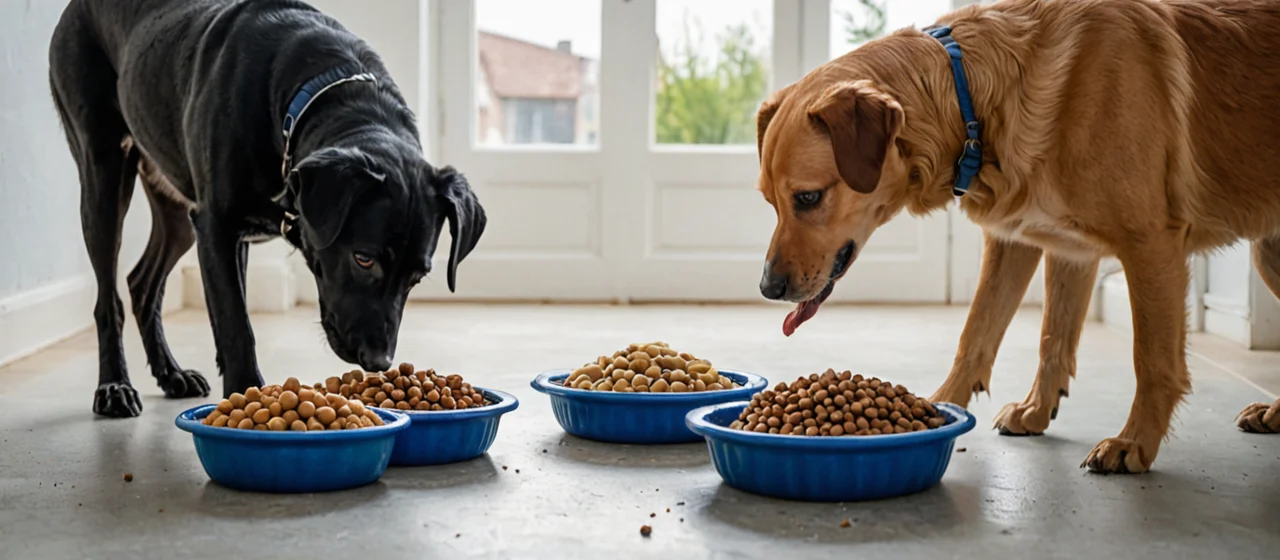
Feeding a pet comes down to three decisions made in a fixed order: what the animal eats, how much of it, and who pays when money is tight. Get the food right and the amount wrong and the pet still suffers; get both right and the money question can still force a change. Everything below is the working version of that sequence — the label mechanics, the numbers manufacturers actually publish, the ways people misread them, and the places where nothing on a bag can help you.
Complete and balanced is a legal claim, not a quality grade
"Complete and balanced" on a dog food label means the product supplies all required nutrients in the right proportions when fed as the sole diet, either by meeting an established nutrient profile or by passing AAFCO feeding tests — standardized animal trials run under Association of American Feed Control Officials procedures. That is the baseline claim every serious food makes. It tells you the food won't starve the animal of anything essential. It tells you nothing about ingredient quality, sourcing, palatability, or how the food will sit in your particular dog's gut.
The distinction that trips people up is between the two routes to the claim. A food can be formulated to meet the nutrient profile on paper, or it can be fed to animals in a trial and shown to work. Purina Pro Plan formulas, for example, carry label statements that animal feeding tests using AAFCO procedures substantiate complete and balanced nutrition for maintenance of adult dogs or for all life stages including growth of large sized dogs. That is a real and meaningful bar. It is not a ranking. AAFCO test statements confirm that a specific diet met the standard for a designated life stage; they do not compare it to another food that also met the standard. Two bags can both say "complete and balanced for maintenance" and be aimed at very different dogs.
Read the life-stage line before anything else on the bag. "Maintenance" means healthy adults not growing, reproducing, or doing intense work — that is a different nutritional target from "all life stages," which has to cover puppies and gestating females and is therefore richer. Feeding an all-life-stages food to a sedentary adult is not dangerous, but it is a mismatch you are paying for. Feeding a maintenance food to a puppy is a genuine error. Large-breed puppies in particular have their own growth concerns, which is why some labels specifically say the food is tested for growth of large sized dogs.
The feeding chart is a starting point tied to a specific cup
Manufacturer feeding charts give daily amounts in cups and grams by body-weight range, and the range within each band is wide because the manufacturer cannot know your dog's activity, age, or metabolism. A 21–35 lb adult dog, per typical manufacturer guidance, gets 1-1/3 to 2 cups of dry food per day. A 76–100 lb adult dog gets 3-1/3 to 4-1/4 cups. Above 100 lb, the standard instruction adds 4-1/4 cups plus 1/4 cup for each additional 10 lb of body weight per day.
Those bands are not interchangeable across formulas, and this is where most overfeeding happens. Purina Pro Plan Performance 30/20, a high-calorie performance diet, calls for 3 to 3-1/2 cups per day for a 76–100 lb dog — noticeably less than the generic 3-1/3 to 4-1/4 cups, because the food is denser. Purina Pro Plan Weight Management Large Breed, for dogs over 100 lb on maintenance, calls for 5 cups plus 1/3 cup for each 10 lb over 100 lb per day. Small-breed formulas run in a completely different scale: Purina Pro Plan Small Breed Chicken & Rice is 1/3 to 1 cup per day for a 3–12 lb dog, and the Small Breed Adult 7+ version is 1/3 to 3/4 cup for the same weight range. Someone who switches from a small-breed chicken-and-rice formula to the senior version and keeps scooping the same amount is feeding above the label.
The cup itself matters. Purina Pro Plan labels specify that recommended amounts are based on a standard 8 oz/250 ml measuring cup containing approximately a stated number of grams of the product — the gram figure lets you check your scoop against a kitchen scale. A random mug from the cupboard is not 8 oz. If you have ever measured what your usual scoop actually holds, you already know how far off it can be. Weigh the food once, in grams, against the label's gram figure for that formula, and you remove the single largest source of quiet overfeeding.
Start at the lower end of the band for a sedentary dog, the middle for an active one, and adjust on body condition rather than on the chart. You should be able to feel ribs under a thin layer without pressing, and see a waist from above. Recheck every few weeks; the chart does not update itself as the dog ages or slows down.
How long food actually stays in the stomach
Feeding frequency and meal timing are not just habits — they interact with how long food sits in the stomach. A peer-reviewed scintigraphy study in Beagle dogs reported a post-feeding mean gastric transit time of 829 minutes, roughly fourteen hours, with esophageal and intestinal transit times shorter and differing between pre- and post-feeding measurements. Gastric transit is substantially the longest segment after a meal.
That number is a study mean in one breed under study conditions, not a rule for your dog. But it explains several things owners notice. A dog that vomits bile in the early morning is often running on an empty stomach overnight, and splitting the daily ration into two meals — which is standard practice for adult dogs anyway — shortens the empty stretch. A dog that is sluggish or picky after a large single meal may simply be carrying a full stomach longer than you expect. And it is why "he ate something hours ago" is not a reason to dismiss a stomach concern: food from a prior meal can still be in there.
Two meals a day is the usual default for adult dogs. Puppies eat more often, and any dog with a veterinary diagnosis gets a schedule from the vet, not from a bag. The 829-minute figure is useful for understanding why timing matters; it is not a target to engineer around.
Body condition beats the number on the chart
The chart gives you a number to start from. Body condition tells you whether that number is right. A dog at the top of its weight band who looks round is being fed too much regardless of what the label permits, and a lean, highly active dog at the bottom of the band may need more than the label's upper limit. The label ranges are wide precisely because the manufacturer is guessing.
Weigh the dog on the same scale at the same time of day, monthly, and write it down. Weight drift is slow and invisible day to day; a scale catches it in weeks. Pair the weight with a hands-on check — ribs, spine, waist — because a dog can lose muscle and gain fat at a constant weight, particularly as it ages. Senior formulas like the Small Breed Adult 7+ exist because nutritional needs shift with age, but the portion still has to match the dog in front of you, not the dog the chart was written for.
Treats count. The daily cup figure is the whole ration, and most owners do not subtract treats from it. If your dog gets a meaningful share of calories from chews and table scraps, the kibble portion comes down. This is the trade-off nobody likes: the chart is easy and the body condition check is work, but only one of them tells you the truth.
SNAP does not cover pet food, and that changes the math
Pet food cannot be bought with SNAP benefits. USDA Food and Nutrition Service guidance on eligible food items explicitly lists pet foods under nonfood items that cannot be purchased with SNAP benefits, so dog and cat food cannot be bought with SNAP EBT. This is one of the most persistent misconceptions in pet care, and it has real consequences for households budgeting tightly.
What that means in practice: the pet food line in a household budget is cash, every month, separate from the grocery benefit. When money is short, the squeeze lands on the pet's diet first, and the cheapest bag is usually the one with the widest feeding band and the least specific life-stage claim. That is a false economy in both directions — a low-density food can require more cups per day, and a poorly matched food can produce more waste and more vet visits. The honest trade-off is that a complete and balanced maintenance food at the correct portion is usually cheaper per day than a bargain food fed generously, but only if you actually measure. If a household is choosing between a smaller bag of a tested maintenance diet and a larger bag of an untested one, the tested food at the label's lower band is the defensible choice.
Food banks and pet-food pantries exist for exactly this gap and are worth knowing about before the crisis, not during it. Nothing here is individual financial advice — the rule is simply that SNAP eligibility does not extend to pet food, and any budget built on the assumption that it does will fail.
The mistakes that cost the most, in order
The most expensive error is free-feeding without measuring. A bowl topped up whenever it looks low makes the feeding chart meaningless and hides how much the dog actually eats. Measure the daily ration once, in the morning, using the label's standard 8 oz cup or a scale, and feed from that measured amount. If food is left after a meal, lift it.
The second is applying the wrong chart. Small-breed formulas, large-breed formulas, senior formulas, and weight-management formulas each carry their own numbers, and they are not close to each other — 1/3 to 1 cup for a small dog versus 5 cups plus for a very large one on a weight-management diet is the same manufacturer, different products, different dogs. When you change formulas, change the scoop amount the same day.
The third is treating an AAFCO statement as a quality ranking. It confirms a diet met the standard for its life stage. It does not tell you which of two compliant foods is better for your dog. That judgment comes from body condition, stool quality, coat, energy, and your vet — none of which are printed on the bag.
The fourth is ignoring the transition. Switching foods abruptly is a common cause of digestive upset; most manufacturers recommend a gradual changeover over several days, mixing increasing proportions of the new food into the old. The 829-minute gastric transit figure is a reminder that the gut is not a fast system, and a sudden change gives it no time to adjust.
None of this requires special equipment beyond a measuring cup that actually holds 8 oz and a scale you already own. It requires reading the life-stage line, using the gram figure on the label to calibrate your scoop, feeding to body condition rather than to the top of the range, and budgeting pet food as cash because SNAP will not cover it. That is the whole system, and it holds whether the bag costs a little or a lot.
Calibrating your scoop to the label's gram figure
Purina Pro Plan labels state that feeding amounts are based on a standard 8 oz/250 ml measuring cup holding a stated number of grams of that specific product. Because kibble density differs between formulas, that gram figure changes from bag to bag — which means a scoop calibrated for one food is wrong for the next. Weigh one level cup of the new food on a kitchen scale, compare it with the gram figure on the label, and you will see how far off your scoop is before the dog does. A cup of a dense performance diet weighs more than a cup of a light weight-management kibble, so switching foods without re-weighing quietly changes the calorie dose even when the cup count stays the same. This is the cheapest correction available: one scale, one minute, once per bag.
Why the same cup count means different calories across formulas
Two foods from the same manufacturer can call for very different daily volumes for the same dog because the formulas differ in calorie density, not because one is more generous. Purina Pro Plan Performance 30/20 asks for 3 to 3-1/2 cups per day for a 76–100 lb dog, while the generic manufacturer range for that weight band is 3-1/3 to 4-1/4 cups — the performance diet is denser, so it takes fewer cups to deliver the same nutrition. The same logic runs the other way for weight-management formulas, where the daily volume is larger. When you change formulas, change the scoop amount the same day, and recheck body condition over the following weeks rather than trusting the old number.